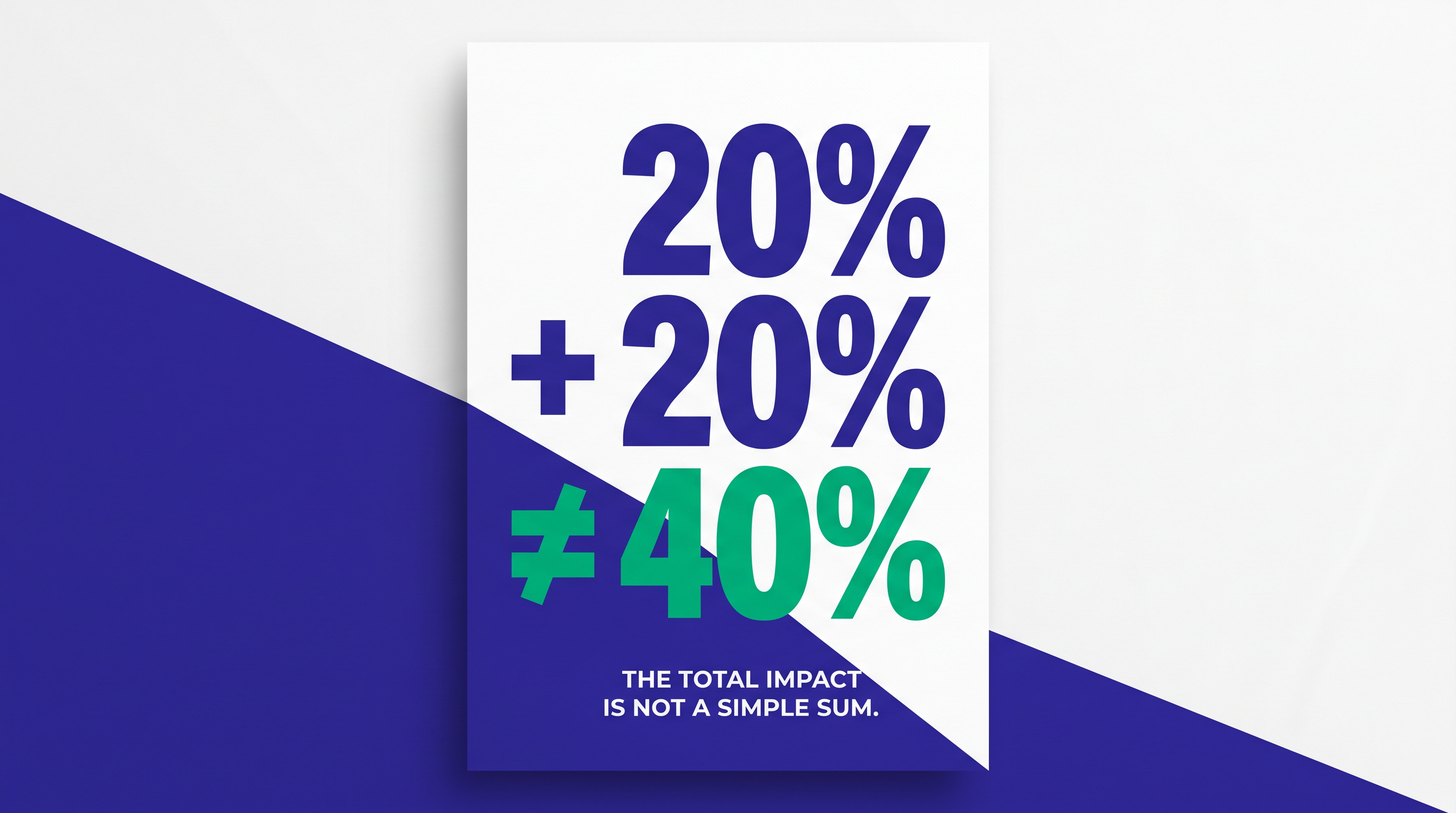
Double Discount Calculator: Why 20% Off + Extra 20% Off Isn't 40% – Successive Discount Formula Explained
The Thrill of the Sale... and the Math That Crushes It
Picture this: You're strolling through your favorite store, eyes scanning the racks for deals. Suddenly, a sign catches your eye—"20% Off Everything!" Your heart races; that sweater you've been eyeing drops from $100 to $80 in your mind. But wait, there's more: "Extra 20% Off at the Register!" Jackpot! You do the quick math: 20% + 20% = 40% off. You're basically stealing it at $60.
Hold onto your shopping cart. That extra 20% isn't applied to the original price—it's on the already-discounted one. You walk out paying $64, not $60. Shocked? You're not alone. This is the double discount trap that snares bargain hunters every Black Friday, retail workers explaining to confused customers daily, and savvy shoppers who want the real scoop. Welcome to the world of successive discounts, where addition doesn't rule and multiplication does. In this guide, we'll demystify the double discount calculator logic, master the successive discount formula, and arm you with tools to calculate true savings like a pro.
The 40% Myth: Why 20% + 20% Equals Just 36%
It's human nature to add discounts. Stores bank on it. But percentages are relative to the price at the time they're applied. A 20% off on $100 saves $20, leaving $80. Now, 20% off on $80 saves just $16, not another $20. Total savings: $36 on $100. That's 36% off—not 40%.
Quick Math Breakdown
Original: $100
- First 20% off: $100 × 0.20 = $20 saved → $80
- Extra 20% off: $80 × 0.20 = $16 saved → $64 final
- Total saved: $36 → 36% off original
This isn't a glitch; it's how how to calculate double discount works every time. Retail workers, next time a customer asks why it's not 40%, you've got the ammo. Shoppers, you'll spot the real value and negotiate better—or just feel smarter at checkout.
The Successive Discount Formula: Your Secret Weapon
Forget adding. The successive discount formula multiplies retention rates. If d1 is the first discount (as decimal) and d2 the second:
Final Price = Original Price × (1 - d1) × (1 - d2)
Total Discount % = 100% - [(1 - d1) × (1 - d2) × 100%]
For 20% + 20%: (1 - 0.20) = 0.80. Then 0.80 × 0.80 = 0.64. You pay 64% of original, saving 36%. Simple, right? This scales to any combo—two, three, even more discounts. It's the backbone of every double discount calculator.
Why does this matter? Because stores advertise "20% off plus extra 20% off" everywhere, from online flash sales to mall clearances. Knowing this formula turns you from mark to master.
Real-World Examples: From $100 Sneakers to $250 Jackets
Let's apply it to everyday buys. Imagine that $100 pair of sneakers:
- First 20%: $80
- Extra 20%: $64
- True savings: $36 (36%)
Scale up to a $250 winter jacket:
- 20% off: $250 - $50 = $200
- Extra 20%: $200 - $40 = $160
- Savings: $90 (36% of $250)
Even smaller: $80 jeans.
- 20% off: $64
- Extra 20%: $51.20
- Savings: $28.80 (36%)
See the pattern? Always 36% for equal 20%s. Bargain hunters, stack these mental calcs while browsing. Retail pros, use them to upsell confidently: "That's effectively 36% off—better than it looks!"
The '50% + 50%' Shock: Why It's Not Free (But 75% Off)
Ever seen "50% Off + Extra 50% Off"? Your brain screams "100% off—free!" Nope. Formula time: (1-0.5) × (1-0.5) = 0.5 × 0.5 = 0.25. You pay 25%, saving 75%. On $100: $50, then $25. Solid, but no giveaway.
This bombshell resets expectations. Stores love the hype; you love the truth. It's why mastering 20% off plus extra 20% off calcs prevents disappointment.
Quick Reference Table: Common Double Discount Combos
Bookmark this for in-store speed. Here's a double discount calculator cheat sheet:
| Discount 1 + Discount 2 | True Total Discount | Retention (What You Pay) |
|---|---|---|
| 10% + 10% | 19% | 81% |
| 20% + 10% | 28% | 72% |
| 20% + 20% | 36% | 64% |
| 25% + 15% | 36.25% | 63.75% |
| 30% + 30% | 51% | 49% |
| 50% + 50% | 75% | 25% |
Pro tip: Higher first discount maximizes savings since the second builds on it.
The Retail Psychology Behind the Hype
Stores aren't evil—they're smart. "20% + extra 20%" uses anchoring (you fixate on 40%) and mental accounting (separate deals feel bigger). It drives foot traffic and impulse buys. Retail workers see it: Customers pile carts thinking they're doubling savings.
But armed with the successive discount formula, you reframe: "36% is still great—better than many singles." Psychology flipped to your advantage.
Pro Shopper Tips: Estimate Double Discounts in Your Head
- Rule of 36: Memorize 20+20=36%.
- Multiply 80s: 20%s? 80% × 80% = 64% paid.
- Reverse engineer: If final seems too good, check formula.
- Compare apples: Always vs. original price.
- Phone calc: Quick (1-d1)*(1-d2).
Bargain hunters, these hacks save time and money. Retail folks, share them to build trust.
Level Up Your Savings Game Today
No more falling for the add-up illusion. With the double discount calculator formula in your toolkit, you're unstoppable. Want instant answers? Head to our free tool at getpercentconvert.com. Plug in any combo—20% off plus extra 20% off or wilder—and get the real deal in seconds.
Shop smarter, save bigger, and smile at the register. The math is on your side now.