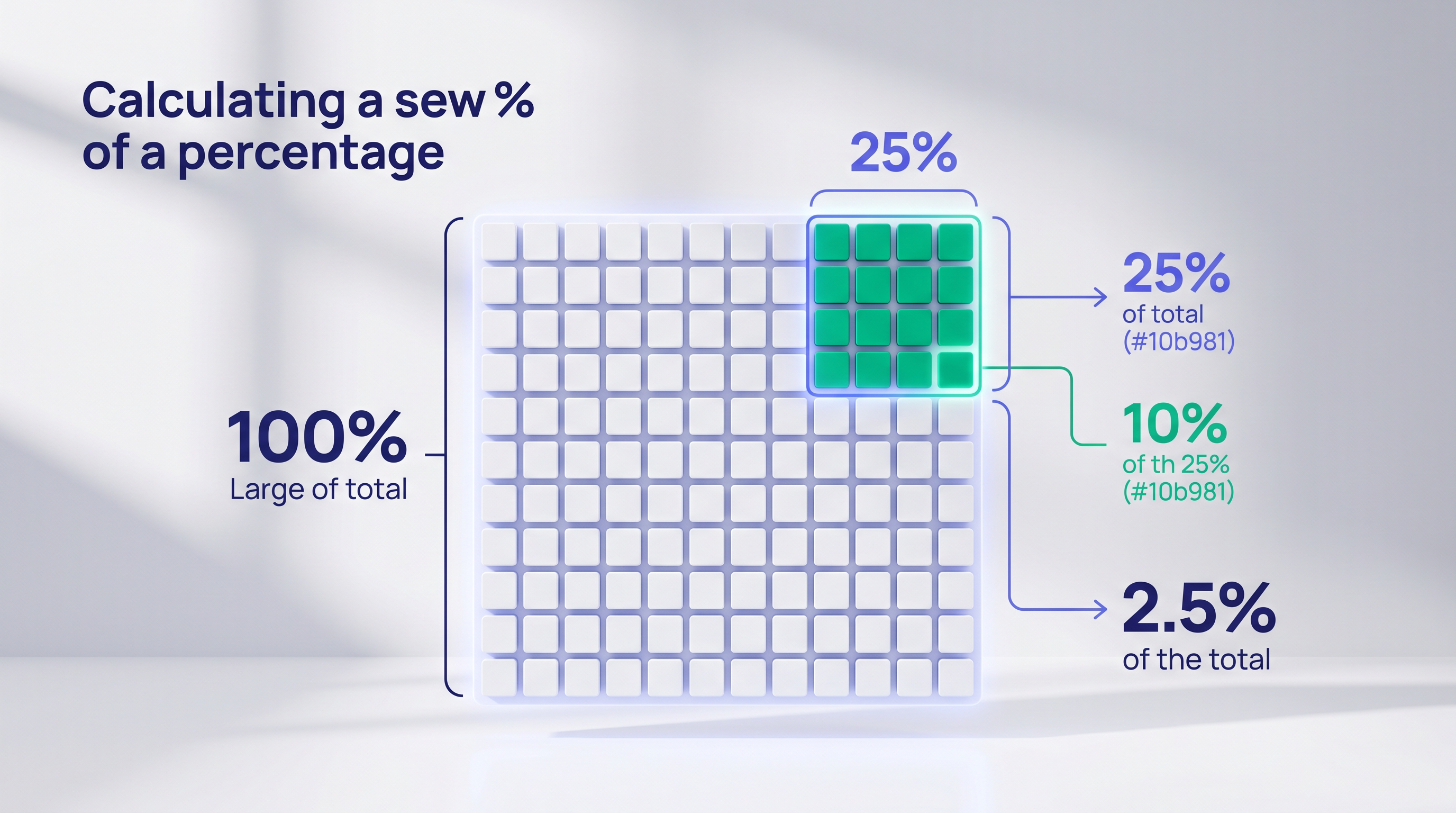
What’s 10% of 25%? How to Calculate Percentage of a Percentage Like a Pro (Step-by-Step)
Imagine you're eyeing a killer deal: a jacket marked down 25% from its original $100 price. Then, the store throws in an extra 10% off the sale price. Your heart races—how much will you actually pay? Is it just 25% + 10% = 35% off? Spoiler: no. That's the trap that snags students cramming for exams, finance pros juggling spreadsheets, and savvy shoppers hunting bargains. The real question burning in your mind? What's 10% of 25%?
Buckle up. This isn't some abstract math puzzle. It's the key to unlocking compound savings, smart investing, and avoiding costly errors that could drain your wallet or derail your budget. We'll crack the code on percentage of a percentage, demystify how to calculate percentage of a percentage, and arm you with step-by-step formulas to master your math. By the end, you'll wield percent of percent calculations like a pro.
The Problem: Why Percentage of a Percentage Trips Everyone Up
Percentages feel intuitive at first—10% of 100 is 10, easy. But stack them, and confusion reigns. You see "25% off, then 10% more," and your brain screams additive magic. Wrong. This is where deals dissolve into duds, commissions compound quietly, and exam scores plummet.
Agitate that pain: Picture splurging on Black Friday, only to realize your "35% total discount" was really 32.5%. That's $2.50 lost per $100 item. Multiply by a cart full of goodies, and you're out $50. Finance folks? Miss a compound percentage calculation on returns, and your portfolio lags. Students? One flubbed question on standardized tests, and opportunities slip away.
Percentages don't add—they multiply. Ignore that, and math bites back.
The Solution: Core Logic of Percent of Percent
Breathe. A percentage of a percentage is multiplication in disguise. To find 10% of 25%, convert to decimals: 0.10 × 0.25 = 0.025, or 2.5%. It's not 2.5% of nothing—it's 2.5% of the whole.
Step-by-Step Formulas to Master Your Math
- Convert percentages to decimals: Divide by 100. 10% = 0.10, 25% = 0.25.
- Multiply: 0.10 × 0.25 = 0.025.
- Convert back (if needed): 0.025 × 100 = 2.5%.
- Apply to base: If base is 100%, result is 2.5% of original.
Pro tip: For chained percentages (like discounts), multiply decimals sequentially against the original base. Head to getpercentconvert.com for instant tools to verify.
Example 1: Basic Percent of Percent – Solving 10% of 25%
Worked-Out Calculation
- 10% = 0.10
- 25% = 0.25
- 0.10 × 0.25 = 0.025
- 0.025 = 2.5%
Real Twist: On a $100 item at 25% off ($75 sale price), 10% more off saves 10% of $75 = $7.50. Total savings: $25 + $7.50 = $32.50, or 32.5% off original. See the multiplication?
Example 2: Stacked Discounts – The Shopping Savior
Flash sale: $200 laptop, 20% off, then 15% off the reduced price. Shoppers add to 35%—big mistake.
Step-by-Step Breakdown
- First discount: 20% off = pay 80% (1 - 0.20 = 0.80). $200 × 0.80 = $160.
- Second: 15% off $160 = pay 85% of $160. $160 × 0.85 = $136.
- Or compound: 0.80 × 0.85 = 0.68. $200 × 0.68 = $136. Total discount: 32% (not 35%).
- Savings: $64 on $200.
- Mistake cost: 5% more, or $10 extra paid.
Master this, and Black Friday bows to you.
Example 3: Commission Fees – Finance Pro's Edge
Sales rep earns 5% commission on revenue, but company takes 20% service fee first. What's the net commission rate?
Compound Percentage Calculation
- Revenue after fee: Pay 80% (1 - 0.20).
- Commission: 5% of that = 0.05 × 0.80 = 0.04, or 4% of original revenue.
On $10,000 sale: Fee: $2,000. Net revenue: $8,000. Commission: $400 (4%). Not 5% of $10k ($500)—that's $100 lost.
- Negotiate smarter with this insight.
- Scale to teams: Tiny % edges compound massively.
Example 4: Investment Growth – Compound Magic
Portfolio grows 10% year one, then 8% on new balance. Not 18% total.
Step-by-Step Formulas
- Year 1: $10,000 × 1.10 = $11,000.
- Year 2: $11,000 × 1.08 = $11,880.
- Compound factor: 1.10 × 1.08 = 1.188. Total growth: 18.8%.
Lesson: Percent of percent fuels wealth. Track at getpercentconvert.com.
Bonus: Tax on Discounted Price
$50 item, 30% off ($35), then 8% tax. Tax on $35: 0.08 × 35 = $2.80. Total: $37.80. Effective rate? Multiply through.
Advanced Tips: Avoiding Pitfalls in Compound Percentage Calculations
- Always use decimals for multiplication—never add raw percents.
- For n percentages: Multiply (1 - p1/100) × (1 - p2/100) × ... for final retention.
- Reverse-engineer: Want 30% total discount? First cut: 20%, second needs ~12.5% (solve 0.80 × (1-x) = 0.70).
- Tools: Excel =A1*(1-0.25)*(1-0.10). Or our homepage calculator.
Patience pays: Practice these, and complexity crumbles.
Master Your Math: Why This Changes Everything
From that jacket deal (32.5% off, not 35%) to boardroom bonuses, how to calculate percentage of a percentage is your superpower. Students ace tests. Pros protect profits. Shoppers stack savings. Next time someone asks, "What's 10% of 25%?" Smile: 2.5%. And you've just leveled up.
Dive deeper at getpercentconvert.com. Calculate confidently—your future self thanks you.